What Is a Cyber attack? How Does It Happen and What Are Its Types?
As our reliance on digital systems grows, cyber attacks have become one of the biggest threats facing individuals, companies, and governments. Understanding the nature of these attacks and their types is the first step toward preventing them. In this article, we explain what a cyber attack means, how it happens, and its most common types.
What Is a Cyber attack?
A cyber attack is a malicious and deliberate attempt by an individual or group to gain unauthorised access to a system, network, or device, with the aim of stealing, disrupting, or destroying data, or achieving financial or political gain. The attack may target infrastructure, personal accounts, or organisational systems.
How Does a Cyberattack Happen?
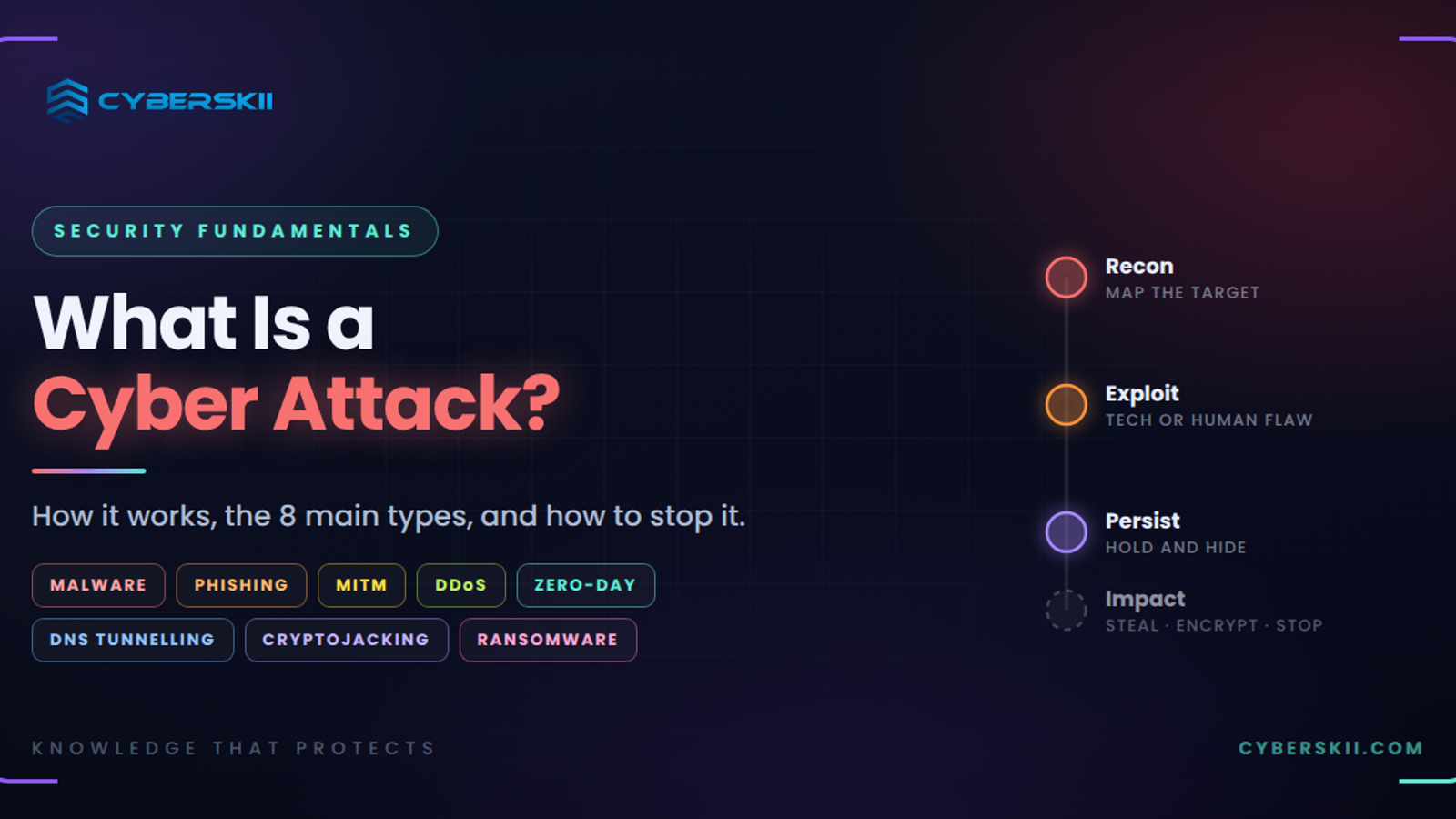
Most cyber attacks pass through successive stages that begin with reconnaissance of the target and gathering information about it, then searching for an exploitable vulnerability — whether a technical flaw in software or a human weakness via deceiving the user. The attacker then carries out the breach and establishes a foothold within the system, before moving to achieve their goal, such as stealing or encrypting data or disrupting service, and may attempt to hide their traces to avoid detection.
Different Types of Cyber attacks
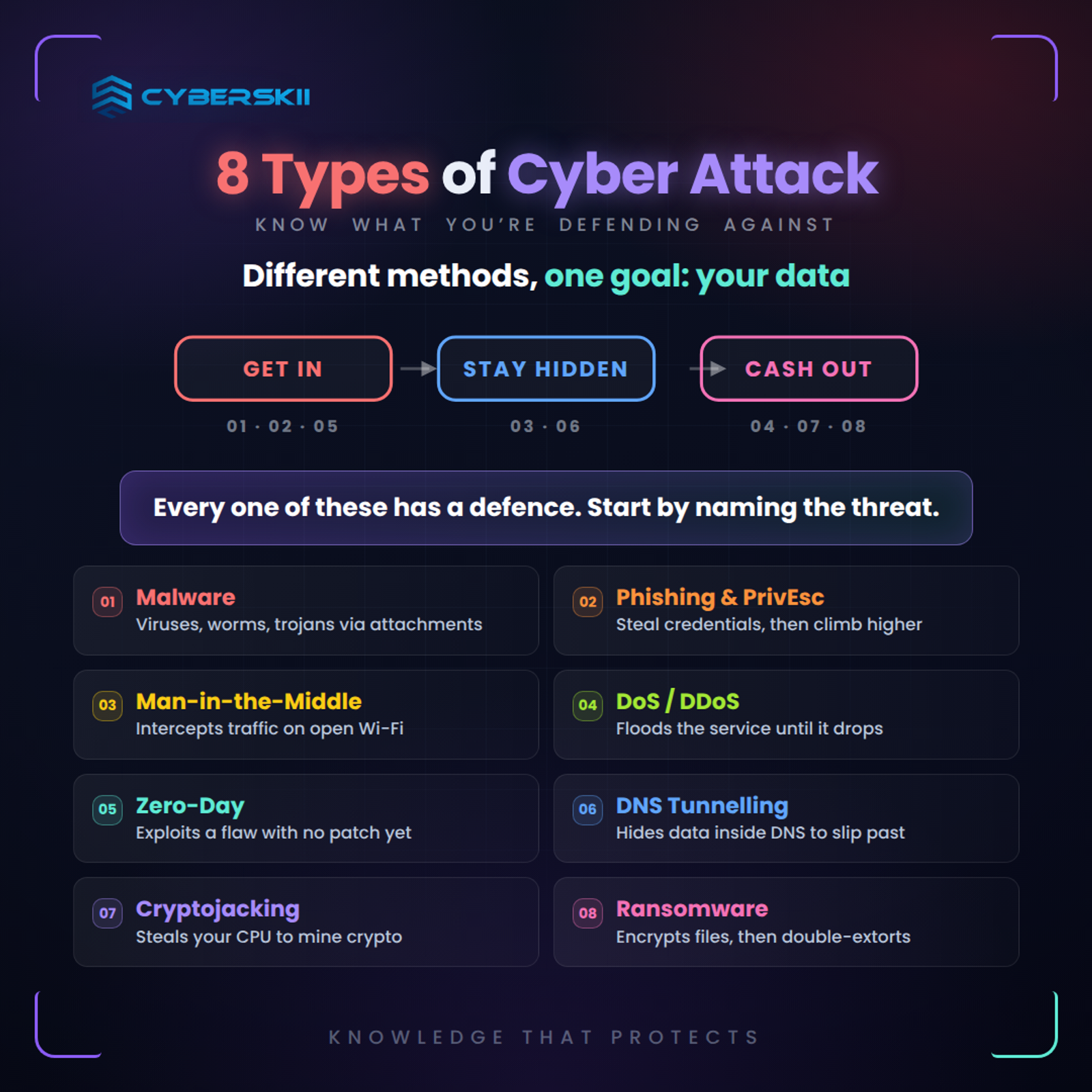
1. Malware Attacks
The attacker uses malicious programs such as viruses, worms, and Trojans to breach the system and steal its data or cause harm. These often infiltrate through email attachments or pirated software.
2. Phishing & Privilege Escalation
The attacker deceives the victim through forged messages to extract login credentials, then exploits them to elevate their privileges within the system and reach more sensitive resources that were not initially available to them.
3. Man-in-the-Middle Attacks
The attacker intercepts the communication between two parties without their knowledge, eavesdropping on or altering the exchanged data. This is common on unsecured public Wi-Fi networks.
4. Denial-of-Service Attacks (DoS / DDoS)
The attacker floods a server or network with a massive volume of fake requests until it stops responding to legitimate users. In the distributed version (DDoS), the requests come from thousands of compromised devices simultaneously.
5. Zero-Day Attacks
These exploit a security vulnerability not yet known to the developer — that is, before a patch is released to fix it — making them among the most dangerous and hardest attacks to repel.
6. DNS Tunnelling
A technique in which the attacker hides malicious data inside Domain Name System (DNS) requests to bypass firewalls and exfiltrate data or remotely control the compromised system.
7. Cryptojacking
The attacker secretly hijacks the resources of the victim's device to mine cryptocurrency for their own benefit, slowing the device and draining its power without the owner's knowledge.
8. Ransomware Attacks
The attacker encrypts the victim's files and demands a financial ransom in exchange for restoring them, and may threaten to publish the stolen data in what is known as double extortion.
How Do You Protect Yourself from Cyber attacks?
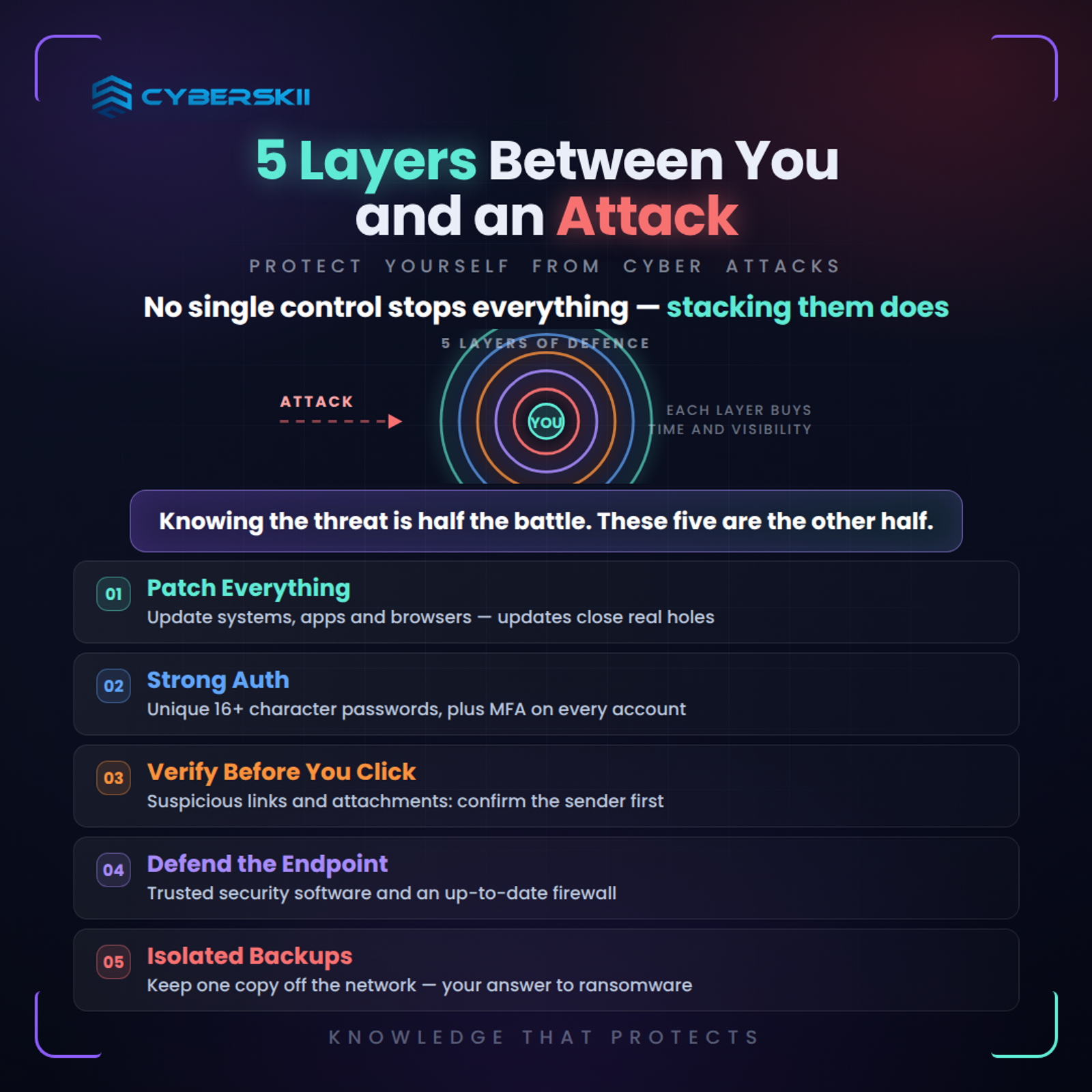
• Continuously update your systems and software to close vulnerabilities.
• Use strong passwords and multi-factor authentication.
• Avoid suspicious links and attachments, and verify the sender's identity.
• Use trusted protection software and up-to-date firewalls.
• Keep regular backups that are isolated from the network.
Conclusion
Cyber attacks are diverse and constantly evolving, but knowing them is half the battle. By applying basic security practices and raising awareness, individuals and organizations can significantly reduce the likelihood of falling victim to these attacks.